The Cost of Masking: (When You’ve Gotten Very, Very Good at Seeming Okay)
What the quiet calibration of every single day actually takes out of your nervous system.
The Cost of “Seeming Okay"
You’re in the right place if you experience a particular kind of tired that comes from spending the day being a slightly edited version of yourself.
This is not a big performance. Not a conscious decision.
Just the constant, low-level calibration of how much you can feel in this room, how much you can show, how much space your real self is allowed to take up right now.
For highly sensitive people, this is masking, and for many of us, we didn't know we were doing it until we stopped.
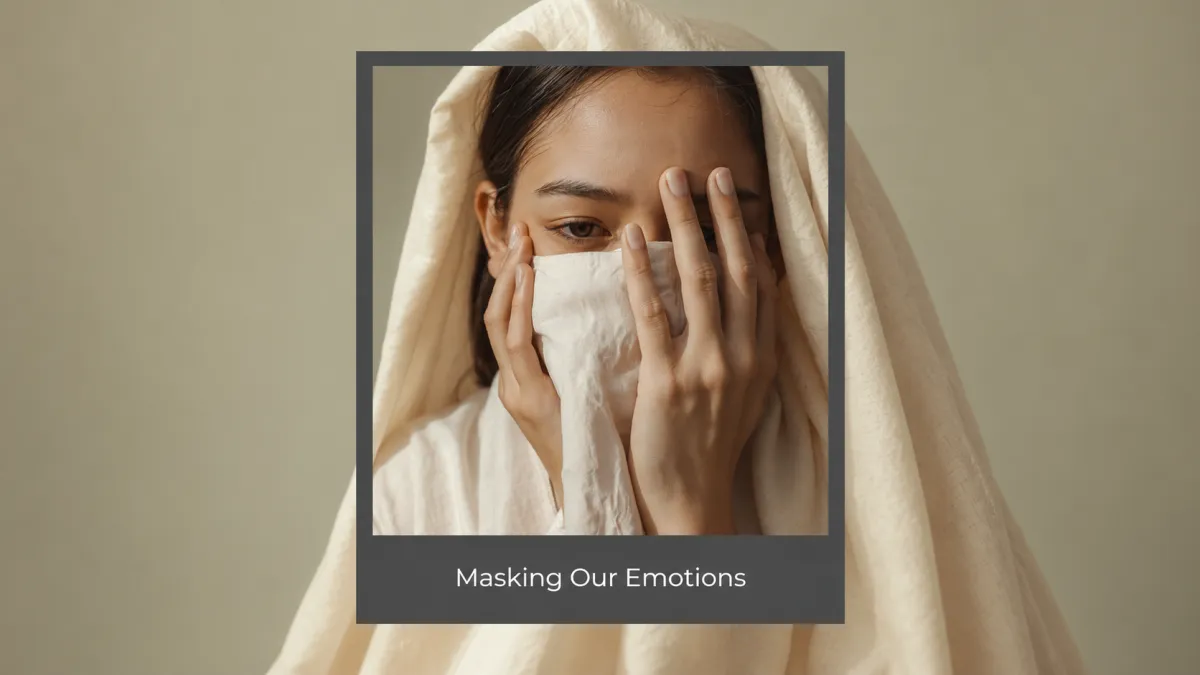
Masking is the small, often unconscious act of hiding your real internal experience so you can seem “fine,” “easy,” or “low maintenance” around other people.
What Masking Actually Costs
Masking isn't dramatic. It isn't lying.
It's the quiet adjustment you make when you're in an environment that wasn't quite designed for a nervous system like yours.
Turning your volume down in a loud meeting.
Holding the emotion instead of letting it land on your face.
Laughing off a comment that actually caught you somewhere tender.
Pretending the fluorescent lights aren't doing what they're doing to your ability to think.
Each adjustment, on its own, is nothing.
But the accumulation... the six, eight, ten hours of small calibrations across a day, is something else entirely.
It is cognitively and emotionally expensive in a way that doesn't show up in any visible way. It just shows up when you get home.
What You Feel After a Masking Day
If you've ever gotten home and felt completely dissolved, not just tired, but somehow... less, that is the cost of a masking day.
The energy that went into being manageable is energy that had to come from somewhere. And the somewhere is always you.
This is not weakness.
Highly sensitive people are not less resilient than other people. They are often significantly more resilient; they've been navigating environments built for different nervous systems their entire lives.
But resilience has a cost.
And the cost is real, whether or not anyone around you can see it.

You’re Allowed to Need Recovery
Decompression is not laziness. The need for quiet after noise is not antisocial.
The feeling of dissolving at the end of a day is not a character flaw.
You are allowed to need recovery time after being around people.
You are allowed to come home and need quiet.
You are allowed to be genuinely tired from a day that looked, from the outside, like nothing special.
It is a very reasonable response to the real cost of spending a day in a world that wasn't designed for the way you process it.
A Soft Landing
If you are carrying a masking hangover today, that drained, foggy “I can’t people anymore” feeling, you don’t need to fix everything.
You just need somewhere to put it down for a moment.
I made something for exactly this moment that you can keep for the days you need a soft landing.
The 90-Second Anchor is free, quiet, and asks nothing of you.
If you prefer doing it through my socials, comment ANCHOR on any of my videos and I’ll send it straight to you.
With you in the moment,
Barb 💜
This post is part of my Masking Week series.
If you missed Post 1, Start here: Masking All Day: The Exhaustion That Has No Name